One Day in Split Old Town
A compact walking plan for Diocletian's Palace, the Riva, Marjan views, and local food.
Reading time: about 7 minutes.
Too Long, Didn’t Read
If you have one day in Split old town, start early inside Diocletian’s Palace, walk through Peristyle, the Cathedral of Saint Domnius area, the Vestibule, and the palace lanes before the crowds build up.
Use the middle of the day for coffee, lunch, shade, museums, or the Riva. In the late afternoon, walk toward Varoš and the first Marjan viewpoint for the best easy view over Split.
The simplest one-day plan is: Palace in the morning, Riva and lunch at midday, Varoš and Marjan viewpoint in the afternoon, dinner in the old town or Varoš in the evening.
Why Split old town works well in one day
Split old town is compact. You do not need a car, and you do not need to rush between distant attractions. The main historic core sits around Diocletian’s Palace, with the Riva waterfront on one side, Bačvice and the ferry port to the east, and Varoš and Marjan to the west.
One day is enough to understand the layout, see the main sights, eat well, and still leave time for wandering. The best plan is not to tick off every corner. It is to move slowly through the palace, take breaks, and let the city open up at different times of day.
Morning: start inside Diocletian’s Palace
Start early, especially from May to September. Diocletian’s Palace is most beautiful before the day-trip groups, cruise visitors, and heat arrive.
Begin around Peristyle, the ceremonial square at the heart of the palace. This is the easiest place to feel the Roman structure of the city. From here, you can see the cathedral bell tower, old stone columns, narrow exits, and layers of later Split life built into the palace walls.
Do not treat the palace like a normal museum with one entrance and one route. It is a living part of the city. People still live, work, drink coffee, and walk through it every day.
Cathedral, bell tower, and Vestibule
The Cathedral of Saint Domnius area is one of the most important stops in the old town. Even if you do not go inside every paid part, spend time around the square and look at how Roman, medieval, and later city life overlap.
If you are comfortable with stairs and heights, the bell tower can be one of the best paid views in the center. If you dislike narrow stairs or heights, skip it and use Marjan later for a wider open-air view.
Near Peristyle, step into the Vestibule, the round imperial entrance hall. It is a short stop, but it gives a strong sense of the old palace scale.
Palace cellars and the waterfront side
The palace cellars are useful when you want an indoor historical stop, especially in summer heat or on a rainy day. They also help you understand the structure of the palace because they mirror parts of the imperial residence above.
After the cellars, continue toward the Riva, Split’s main waterfront promenade. This is not a place to hurry through. Sit for coffee, watch the ferries and people, and reset before the next part of the day.
Midday: coffee, lunch, and shade
By midday, especially in summer, the old town gets hotter and busier. This is the right time to slow down.
Good midday options:
- coffee on or near the Riva
- lunch in the old town or Varoš
- palace cellars or a museum if it is too hot
- a short rest at your accommodation if you are staying nearby
- a swim at Bačvice if you want to mix sightseeing and beach time
Do not over-plan lunch. In the old town, the best choice often depends on where you are when you get hungry and whether you want a quick meal, a konoba-style lunch, seafood, pizza, or something simple.
Early afternoon: wander the small streets
After lunch, walk without a strict checklist. Some of the best old town moments are in the small lanes between Peristyle, Pjaca, Fruit Square, and the western side of the palace.
Look for:
- stone courtyards
- narrow passages
- old doorways
- small churches
- laundry lines above the lanes
- quiet corners just one street away from the busiest route
This is also a good time to buy something small, stop for gelato, or sit in the shade. Split old town rewards short pauses.
Late afternoon: Varoš and Marjan viewpoint
In the late afternoon, walk west from the old town toward Varoš, one of Split’s old neighborhoods. The streets become smaller and more residential, with stone houses, steps, and a different feeling from the palace core.
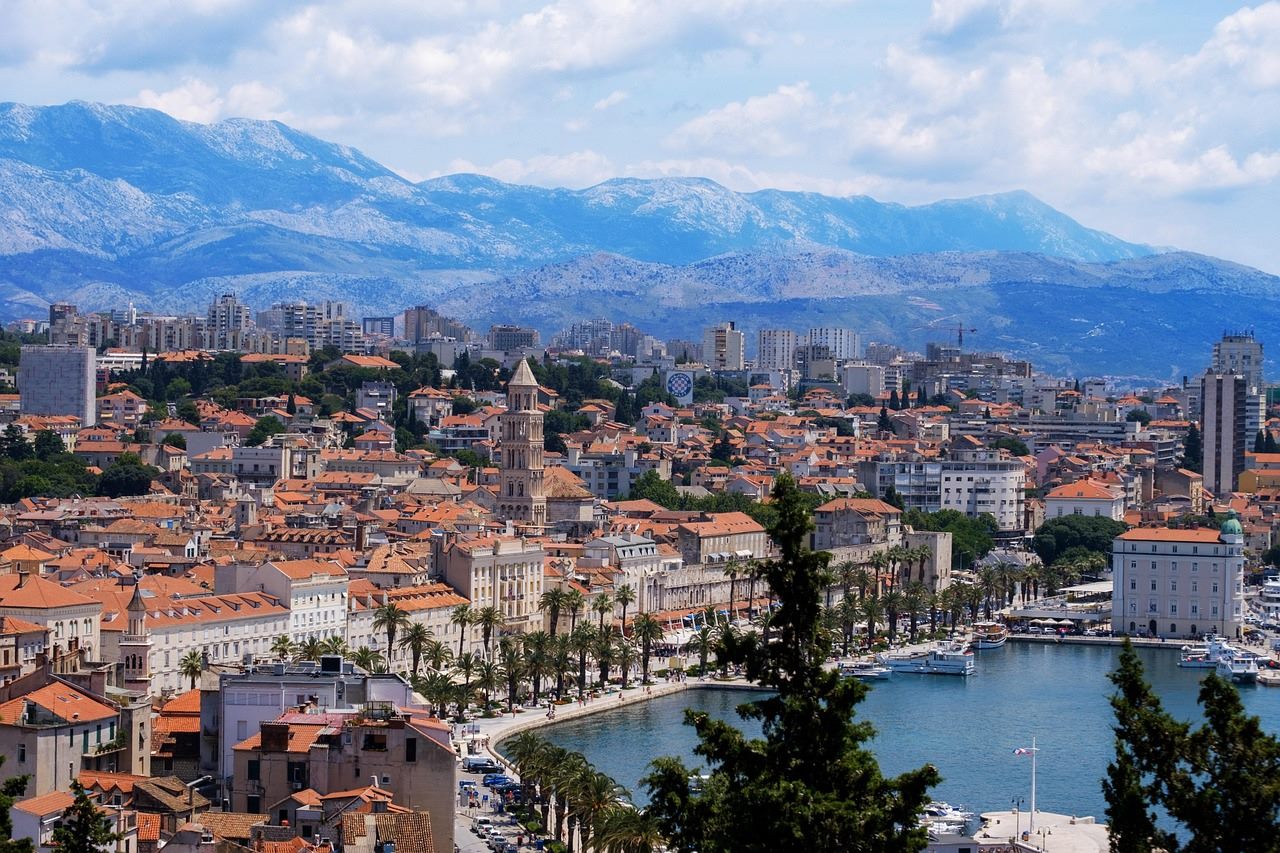
From Varoš, continue toward the first Marjan viewpoint. You do not need to hike deep into Marjan to make this worthwhile. Even the first viewpoint gives a strong view back over the old town, Riva, harbor, and islands.
This is one of the best ways to understand Split’s shape: palace below, sea in front, Marjan behind, and mountains in the distance.
In summer, do this later in the day. The stone and steps can be hot, and the view is better when the light softens.
Evening: return for dinner
After Marjan, return toward Varoš, the Riva, or the old town for dinner.
Choose Varoš if you want a quieter, more local-feeling dinner street. Choose the old town if you want to stay in the middle of the evening atmosphere. Choose the Riva if you mainly want a drink, a walk, and people-watching rather than the best meal.
After dinner, walk through the palace again. Split feels different at night, especially around Peristyle, the narrow lanes, and the waterfront.
Simple one-day route
Use this as a flexible route, not a strict schedule:
- Peristyle
- Cathedral of Saint Domnius area
- Vestibule
- Palace cellars
- Riva coffee break
- Pjaca and Fruit Square
- Lunch
- Old town lanes and small churches
- Varoš
- First Marjan viewpoint
- Dinner in Varoš or old town
- Evening walk through the palace
Summer version
In July and August, heat changes the plan.
Start earlier, keep the palace and main sights for the morning, and avoid climbing toward Marjan in the middle of the day. Use midday for lunch, shade, museums, a rest, or a swim.
A good summer rhythm is:
- morning: palace and old town
- midday: shade, lunch, rest, or beach
- late afternoon: Varoš and Marjan viewpoint
- evening: dinner and old town walk
Carry water, wear a hat, and do not underestimate how hot the stone streets can feel.
Rainy-day version
If it rains, keep the route compact. Stay inside the palace area, use the cellars, visit indoor sights, sit for coffee, and save Marjan for another day.
Rain does not ruin Split old town. The stone streets can look beautiful in wet weather, but they can also be slippery, so wear shoes with decent grip.
City Day and local traditions
If you are in Split around City Day of Split, the old town and cathedral area become more important than usual. Local traditions, religious celebrations, processions, and events are connected with Saint Domnius, the city’s patron saint.
On those days, check the current program and expect more people around the cathedral, Riva, and main squares. It can be a very good time to be in Split, but it is not a normal quiet sightseeing day.
Practical tips
- Start early if you want quieter streets.
- Wear comfortable shoes; the old stone can be uneven and slippery.
- Do not try to see every paid sight in one day.
- Use Marjan for the best easy overview of the city.
- Keep lunch flexible.
- In summer, avoid the steepest walks at midday.
- In winter, use sunny hours for walking and keep indoor stops for wind or rain.
- If you are catching a ferry, remember that the port is close, but crowds and luggage slow everything down.
Is one day enough?
One day is enough for the old town, Riva, Varoš, and a Marjan viewpoint. It is not enough for everything around Split.
If you have a second day, use it for beaches, a proper Marjan walk, Klis Fortress, Trogir, Salona, or an island trip. But for the old town itself, one well-paced day works very well.